Round Redfish
Redfish, red drum, puppy drum, red bass, channel bass, or spottail bass, whatever you call them, these coastal marauders spell plenty of great year round fishing for the Georgia angler savvy enough to follow their habits.
Spottails are members of the drum family, a family name that comes from the drumming sounds they make with their air bladders. Many people don't know that the spotted seatrout is also a member of this family.Red drum can truly be caught at any time of the year. They are relatively easy to catch, and we have lots of anglers fishing for them, more very year.
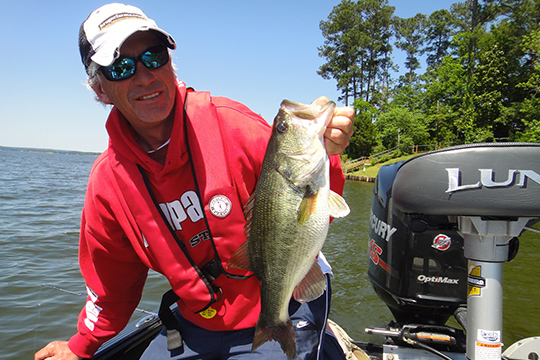
If we are to continue to have replenishable stocks of red drum for future years, we must pay strict attention to the conservation efforts that the Georgia DNR Coastal Resources Division has put in place. The fact that these fish don't reach breeding maturity until five years of age means that we must make sure we return to the water unharmed the majority of the smaller fish we catch.
Red drum can be found along the entire Georgia coast, from the St. Mary's River to the Savannah River and everywhere in between. But exactly where along the coast they will be and how you fish for them is dependent on what time of year you fish. Reds follow a definite cycle during breeding, brooding and growing.
Knowledge of this life cycle coupled with a like knowledge of the Georgia coastal geography can help you catch fish all year long.
The entire coast of Georgia is comprised of salt marshes divided by hundreds of small creeks, rivers, shallow mud flats, and oyster bars. Protecting these marshes are the barrier islands. Often as high as thirty feet above sea level, these barrier islands were created by thousands of years of sand-pounding surf building up the beaches. Jekyll, St. Simons, Sapelo and the many other barrier islands offer this marsh protection.
To understand the life cycle of this fish, you must understand that red drum don,t reach sexual maturity until they are at least five years old. They will be from twenty-seven to thirty inches in length and weigh over fifteen pounds at this stage in their life.Many people think that the red drum needs brackish or freshwater in which to breed. While they do need this backwater, it is not for breeding, but for brooding.
From July through September, large fish migrate offshore out of the cuts and inlets to breed. Large females may spawn several times during these months, broadcasting several million eggs into the water for the accompanying males to fertilize. Huge schools of drum have been sighted offshore just under the water surface by surveillance aircraft during these breeding periods. This large-schooling habit during the breeding season, and relative ease of detection have made them easy targets for commercial net boats in the past, causing devastation to future populations.Life begins for a red drum well off the coast where the eggs hatch from August through October. The hatchings begin to grow immediately, and larval stages of the fish can be found in and around the beaches near cuts through the barrier islands.
Tidal currents take the growing larvae far back into the marsh creeks and rivers. For the first winter of life, they will remain in the marsh, relatively protected from predator fish. The following spring and summer they will make their way to the lower reaches of the rivers and sounds.
At this stage of life and for the next three to four years, the red drum will remain within these estuarine waters, feeding mainly on shrimp and crabs, and growing to maturity. It is during this period in their life that the majority of fish are caught by hook and line.
FALL :
Fall fishing for red drum can be some of the most productive fishing, particularly for the larger brood fish. The breeding cycle has been completed and large fish are roaming the surf looking for food. Huge schools of baitfish, including mullet and menhaden are found migrating south along the beaches to escape the coming cold weather.
Bluefish schools will be right with the baitfish, gorging themselves at every chance as they turn the water to a froth. Pay attention to the bluefish, because not only are they fun to catch, they are accompanied by big red drum.It is not uncommon for a drum to chase and eat baitfish, but in relatively deep water, the drum have a harder time catching the baitfish. Drum are primarily bottom feeders, able to move from side to side quickly in pursuit of prey. But baitfish in deeper water can move vertically, something the drum has trouble doing.What the big drum have learned to do is follow the bluefish and look for the leftovers. Pieces of baitfish cut up by the sharp teeth of the blues drift to the bottom where the big reds are scavenging.
WINTER :
Winter can be the most difficult time to find red drum, but they can be caught when you locate them. The smaller brood fish spending their first winter in the creeks are particularly susceptible to temperature extremes. Sudden cold fronts can kill small fish if they do not move to warmer water quickly.Look for fish during the middle of the day, in shallow water that is being warmed by the sun. Often an entire school comprised of hundreds of fish can be found in one shallow sound. And it is literally possible to catch every single fish. So, again, take care of your catch and practice an easy release. Lower reaches of the Ogeechee, Canoochee, Altamaha, and St. Marys Rivers all have creeks and feeder creeks that will hold fish during the middle of the day.
SPRING :
By spring, the water has warmed and brood fish have reached ten to twelve inches in length. Back in the creeks and marshes, these fish can be caught in the same places day after day on an outgoing tide. They have learned to move with the tide to the deeper creek waters to avoid being stranded in a shallow pool. This habit has them passing the same cut or point, and moving in the same channels tide after tide. When the tide changes and begins to rise, they will again move back into the creeks.Schools of red drum will generally segregate by size. When you begin catching small fish, you can be assured that the entire school will look like they came out of the same mold. So if you are looking for larger fish, you will need to find a different school, perhaps in a different creek.Try this. At dead low tide, locate a creek you can navigate, and identify the surrounding bottom structure that is out of the water. Make notes on channels, oyster bars and cuts. If you know where you can take your boat on a high tide without fear of being left high and dry on the low tide, you can successfully navigate the creeks and find the fish.